
Political Violence, SRCC and Geopolitical Risk: Howden Re’s view from the 1.1 renewal
 Prefer us on Google


Political violence, strike, riot & civil commotion (SRCC), and broader war-related risks remain firmly in focus as the reinsurance market moves beyond 1 January 2026 renewals. 2026 has begun with further heightened geopolitical volatility and structural change following a year which reinforced political risk as a persistent feature of the global risk environment rather than a transitory concern.
Heightened risk volatility has been one of the few constants in a period of near-perpetual change. Strategic competition between major powers has intensified, whilst intrastate conflict and localised confrontations between governments and disaffected factions including non-state actors, continue to rise. At the same time, the reconfiguration of the global economic and geopolitical system has become unmistakable, with profound consequences for security, capital allocation and political stability.
These dynamics have resulted in a sustained elevation in loss expectations. Global insured catastrophe losses have exceeded US$100 billion in every year of the current decade, creating new challenges for insurability and reinforcing the crucial role of insurance. Higher inflation, structurally lower growth and more frictional trade further complicated underwriting and portfolio management.

Political violence and SRCC risks are no longer peripheral considerations for the market. After several years of sustained geopolitical volatility and structural change, reinforced by elevated loss expectations across the current decade, these risks have moved decisively into the core of underwriting and capital decision-making. They are increasingly central to how capital is deployed, portfolios are structured and risk is assessed.
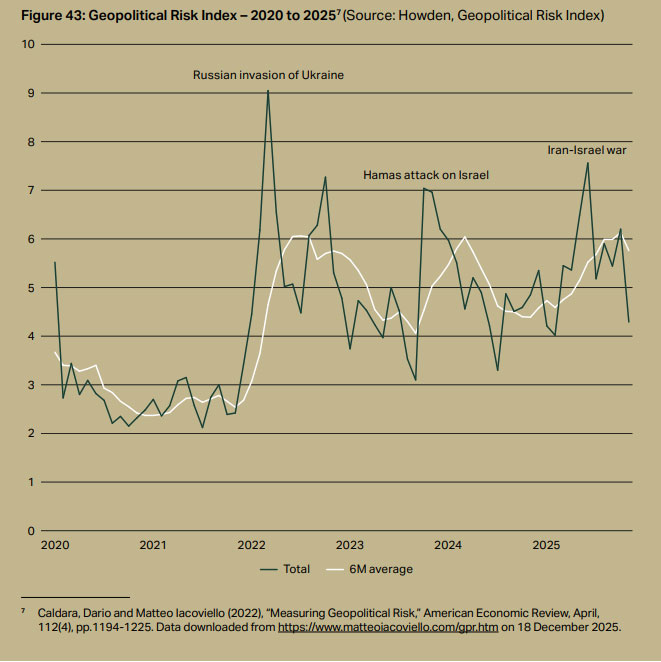
Risk indicators have risen markedly in the 2020s, driven primarily by wars in Ukraine and the Middle East. The brief but intense conflict between Iran and Israel triggered a sharp, albeit short-lived, spike in geopolitical risk, highlighting the speed with which conditions can deteriorate and the challenges this creates for risk modelling and aggregation. 2025 was therefore already marked by shifting geoeconomic risks that fed directly into 1 January renewal discussions. Post-renewal actions in Venezuela and mounting concerns around Greenland are leading to the potential for near-term supply chain shocks and testing longstanding security alliances.
Hybrid warfare activity has also increased, with cyber attacks, drone incursions and sabotage more prevalent. Hostile actors are leveraging modern technology to target critical infrastructure, defence-industrial assets and aviation operations while obscuring attribution, further blurring the boundaries between political violence, war and economic disruption.
Developments in Venezuela in January 2026, including the United States’ strike and capture of President Nicolás Maduro, the subsequent change in political leadership and potential changes to regional and global energy supply dynamics, serve as a timely illustration of how quickly geopolitical conditions can shift. Whilst the longer-term implications remain uncertain, these events highlight the challenges for risk assessment, aggregation and capital deployment in an environment where political and economic risks can converge at speed.
David Flandro, Head of Industry Analysis and Strategic Advisory, said: “We are seeing a broadening of geopolitical risk: direct disruption through unilateral action and coercive statecraft, and indirect disruption via hybrid activity are becoming the norm. This blurs the traditional boundaries between political violence, war and economic disruption, with important implications for how risk is understood, modelled and ultimately transferred.”
More than two-thirds of multinationals now use political risk management tools with usage expected to rise further later this decade. Political risk modelling constituted the largest increase of any risk management framework, consistent with strong growth observed during 2025.
Persistent geopolitical and macroeconomic uncertainty is expected to continue driving demand for political violence, SRCC and political risk (re)insurance in 2026. Coverage plays an increasingly important role in supporting cross-border investment and enabling more resilient supply chains across strategic sectors, including critical minerals, defence and advanced technologies.
Whilst awareness is rising, a lack of understanding remains a key barrier to broader uptake, with many organisations still underutilising available solutions. This presents a clear opportunity for the market: for insurers and reinsurers to meet evolving client needs in a high-demand environment, and for buyers to access high-value protection that can deliver tangible benefits, including improved financing outcomes and cost-of-capital efficiencies.
David Flandro added: “In an environment of persistent global instability, political risk insurance is not only a protective tool, but also an enabler of investment, resilience and more efficient capital allocation. As geopolitical and macroeconomic uncertainty becomes more entrenched, coverage is increasingly being used to support cross-border investment, strengthen supply chains and unlock financing across strategic sectors, including energy, defence and advanced technologies.”
Political violence and SRCC risks are expected to remain elevated in 2026 reflecting heightened geopolitical volatility and macroeconomic uncertainty influencing global risk conditions. The 1 January renewal demonstrated that, in the absence of a market-changing loss, these risks continue to be viewed as insurable, with capacity, expertise and capital available to support clients navigating an increasingly complex global landscape.
Richard Miller concluded: “Looking ahead, the sustainability of current conditions will ultimately be driven by loss experience and capital dynamics rather than headlines alone. Absent a significant market-changing event, we expect political violence and SRCC markets to remain competitive and well supplied in 2026.”