Howden Re Webinar on Shrink–Swell Subsidence Risk (RGA) in the Context of the “Cat Nat” Reform in France
 Prefer us on Google


Howden Re Paris hosted its inaugural webinar on 11 December 2025, in partnership with Reask, to examine how Subsidence risk in France is evolving in light of climate trends and the new Natural Catastrophe (Le régime d'indemnisation des catastrophes naturelles and heren referred to as "Cat Nat") regime. The event brought together around twenty cedants from the French market, alongside representatives of insurance and reinsurance industry associations.
The session was chaired by Thomas Kroely (Managing Director) and Arthur Pons (Director) of Howden Re, with insights from Reask co-founders Thomas Loridan (Chief Science Officer) and Nicolas Bruneau (Head of Research).
Climate conditions shaping shrink–swell subsidence exposure in 2025
Overall, 2025 ranks among the hottest years ever recorded in France. Both spring and summer were exceptionally warm, marked by abnormal and prolonged heatwaves. Rainfall patterns showed sharp contrasts between the northern and southern regions of the country, resulting in pronounced soil drought conditions unique to these areas. Nicolas Bruneau commented that "we continue to see a pattern of hotter, drier summers that directly amplify soil movement risk."
Understanding and measure soil mechanics
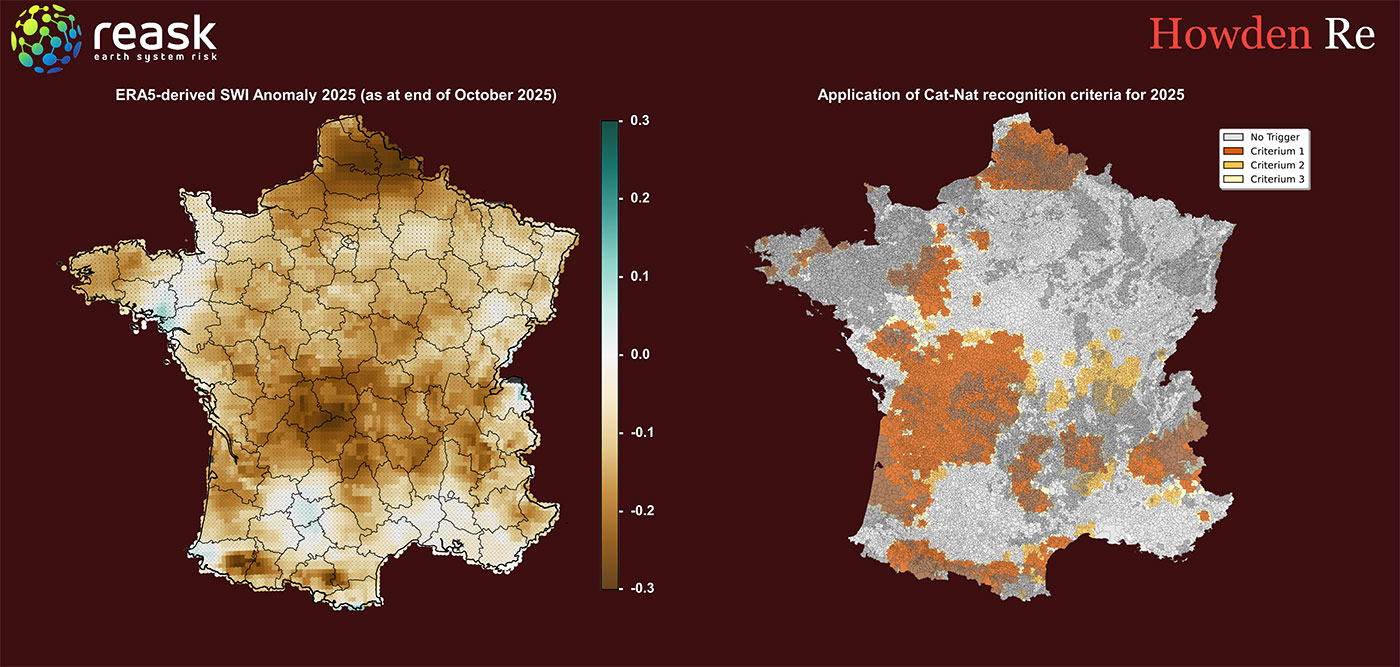
The risk of clay shrink–swell is primarily driven by variations in soil moisture content. The Soil Water Index (SWI) provides a quantitative measure of volumetric soil moisture, indicating how saturated the soil is relative to its field capacity. Using the European ERA5 dataset, an SWI can be generated on a monthly basis, enabling projections as early as October for the current year. This approach also incorporates both soil typology and vegetation cover. Importantly, the resulting index shows a strong correlation with the SWI published annually by Météo France.
A more transparent “Cat Nat” regime
The 2024 reform of the “Cat Nat” scheme in France marks a turning point. It introduced clearer recognition criteria based on the annual minimum of the Soil Wetness Index rather than seasonal anomalies. Nicolas Bruneau emphasised that “the new regime provides a more objective framework, but it also changes the geography of recognitions, which is particularly important for insurers.”
Thanks to work done on the ERA5 dataset, the preliminary analyses conducted by Howden Re and Reask suggest that around 11,500 municipalities could meet the “Cat Nat” drought criteria in 2025, leading to market losses estimated between 1.2 and 1.6 billion euros.
Why stochastic modelling is essential under a changing environment
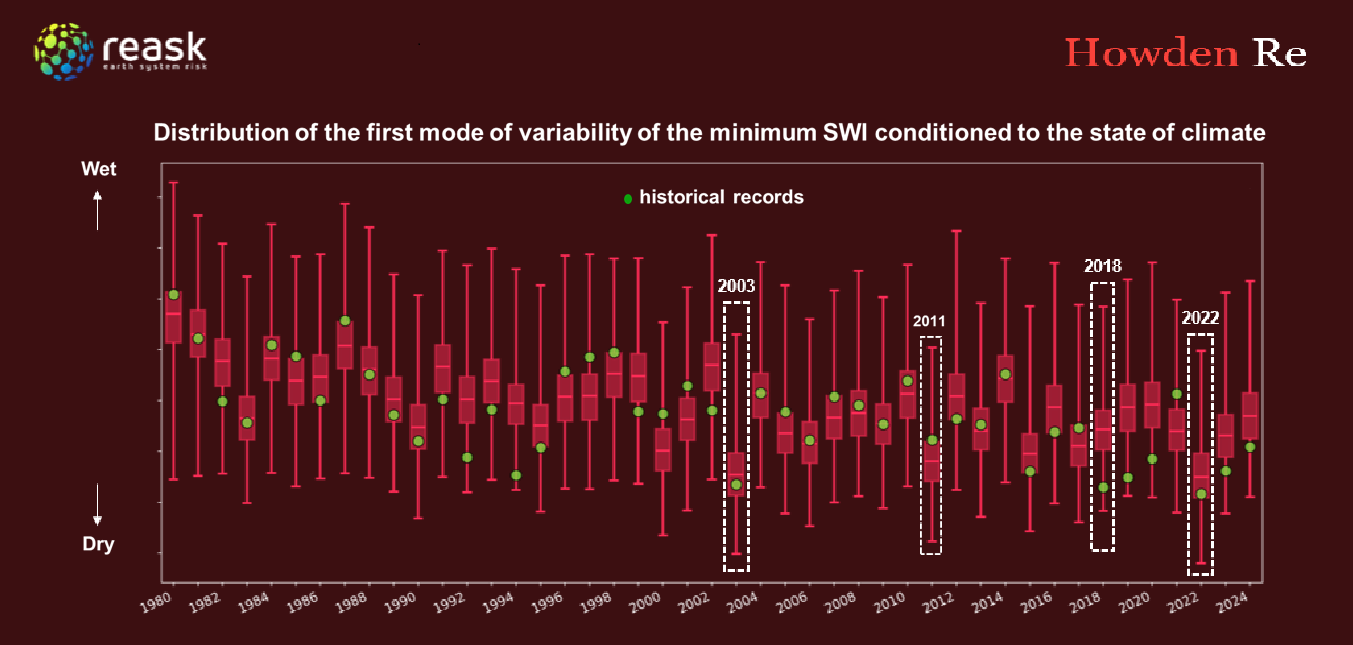
Nicolas Bruneau emphasised that “historical data alone cannot fully capture today’s risk landscape. We need probabilistic views that reflect the climate we are actually living in.” The use of climate conditioned stochastic modelling therefore enables the generation of thousands of drought scenarios to quantify the impacts of both the evolving “Cat Nat” regime and ongoing climate change. For example, if 2025 had replicated the spatial drought pattern observed in 2018, “Cat Nat” recognitions would have been ~32% lower.
Reinsurance innovation
Current Subsidence reinsurance covers provide few effective alternatives or complements to the CCR program, constrained either by limited capacity (traditional structures) or excessive risk financing (structured approach). Developing innovative solutions has therefore become essential to foster stronger alignment between cedants and reinsurers.
Howden Re has developed two forward‑looking approaches: a Hybrid Aggregate structure combining parametric (Subsidence) and indemnity (other climate perils) elements to deliver frequency protection while diluting basis risk, and a multi‑year parametric solution with an endowment fund that gradually offsets basis risk over time. Both approaches showcase new ways of addressing Subsidence reinsurance and strengthening reinsurers’ technical engagement to maximise capacity deployment.
Looking ahead
Thomas Kroely concluded by emphasising the growing importance of this peril. "Shrink–swell subsidence is no longer a marginal exposure. It is becoming a defining feature of France’s natural catastrophe landscape. Our role is to equip clients with the insight and tools needed to navigate it confidently."
To explore the findings further or discuss Subsidence risk in France, please contact Howden Re Paris at [email protected].